World logo

Apps

  • World App
  • World ID App
    • Orb 정보
    • Orb를 찾아보세요

World ID Products

  • World ID
  • World for Zoom
  • Selfie Check

Solutions

  • World for You
  • 기업을 위한 World
  • 정부를 위한 World
  • 개발자를 위한 World

Discover

  • World 소개
  • World 블로그
  • World 플래그십

Protocol

  • World Chain

Resources

  • 백서
  • World 튜토리얼 센터
  • 지원
  • 오픈 소스
  • 개인정보 보호
  • 미디어 센터
  • 채용
  • World 재단
검색

World 뉴스레터 구독하기

최신 World 업데이트를 가장 먼저 받아보세요.

이메일 주소를 입력하고 "구독"을 클릭하면 뉴스레터, 마케팅 커뮤니케이션, 생태계 업데이트 수신에 동의하는 것으로 간주됩니다. 귀하의 권리와 그 행사 방법을 포함해 당사가 개인 데이터를 처리하는 방식에 대한 자세한 내용은 개인정보 처리방침을 확인해 주세요.

World ID
World App
World ID App
World Chain
World 소개
World 플래그십
World 블로그
World View
World Tech
World for You
기업을 위한 World
정부를 위한 World
개발자를 위한 World
Orb 정보
Orb를 찾아보세요
개인 오퍼레이터
커뮤니티 오퍼레이터
리테일 오퍼레이터
백서
오픈 소스
개인정보 보호
미디어 센터
World 재단
World 튜토리얼 센터
지원
자주 묻는 질문
채용

X

WhatsApp

LinkedIn

Telegram

YouTube

Instagram

TikTok

Reddit

*Worldcoin (WLD) 토큰의 대상 자격은 지역, 나이 및 기타 요인에 따라 제한됩니다. World Assets, Ltd.와 World Foundation은 중앙화 또는 탈중앙화 거래소와 같은 제3자 플랫폼에서 WLD를 이용할 수 있는지에 대해 책임지지 않습니다. 자세한 내용은 https://world.org/legal/user-terms-and-conditions에서 확인하세요. 암호화폐 상품에는 높은 위험이 따를 수 있습니다. 중요 사용자 정보는 https://world.org/risks에서 확인할 수 있습니다.


™ 2026 World

쿠키 설정쿠키 정책개인정보 보호 공지상표 정책데이터 요청사용자 약관위험커뮤니티 알림
World 튜토리얼 센터이 페이지

Improving Digital Trust on Tinder with World ID

2026년 8월 17일 ▪ 4 분 읽기
Building trust in the age of AIResults at a glanceBuilding on an existing investment in trustSolving the privacy paradoxTurning verification into a better user experienceWhat’s next

Building trust in the age of AI

Every day, millions of connections begin on Tinder. Behind each interaction is a simple assumption: there is another real person on the other side of the screen.

As artificial intelligence makes it easier to create synthetic profile photos, automated conversations, convincing impersonations and sophisticated romance scams, that assumption is becoming harder to guarantee. 

“We are having a [digital] trust crisis,” says Tomoaki Umeki, Head of Tinder, Japan.

For Tinder, this creates a challenge that goes beyond detecting harmful content. The company must continue giving people confidence that the connections they make online begin with real people.

Tinder believes the fundamental reason people use its platform has not changed. “People have been looking for a real, authentic connection with each other,” Umeki says. “The first criteria for a genuine connection is that the user is a real human.That’s the foundation.”

“People have been looking for a real, authentic connection with each other. The first criteria for a genuine connection is that the user is a real human.”

Tomoaki Umeki, Head of Tinder, Japan.

What is changing is the infrastructure required to protect that experience. We sat down with Umeki to discuss Tinder’s approach to AI, its investment in trust and safety, and why the company added World ID as another layer of verification for users in Japan.

Results at a glance

  • Added a privacy-preserving proof-of-human verification option for Tinder users in Japan
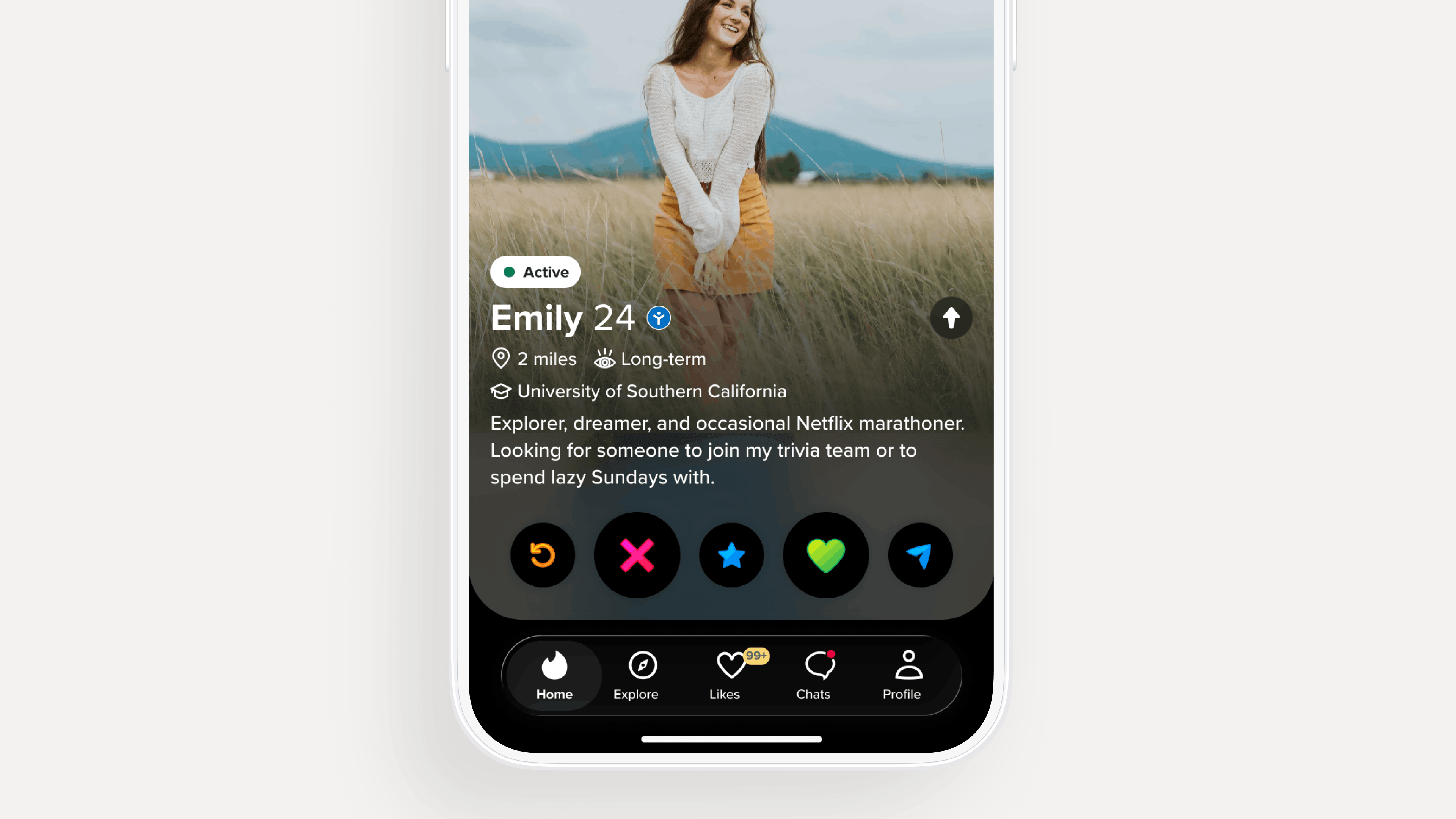
  • Introduced a visible signal that helps users recognize people who have completed the additional verification
  • Complemented Tinder’s existing face verification, moderation, scam detection and reporting systems
  • Established a foundation for measuring how proof of human influences trust and user behavior

Building on an existing investment in trust

Trust and safety has long been a major operational priority for Tinder and its parent company, Match Group.

According to Tinder, Match Group invests approximately $125 million annually in Trust & Safety, driving meaningful advancements in portfolio-wide security and industry standards. That work includes face verification, moderation, human moderation, scam detection and safety-reporting tools.

“We put a lot of effort into preventing negative experiences caused by scammers,” Umeki says. These systems help identify suspicious behavior, moderate harmful content and respond to abuse. But Tinder continually evaluates whether its protections are keeping pace with changing threats. “We have to think from the user’s perspective: Are we doing enough?” Umeki says. “If not, what can we do differently?”

That question led Tinder to pursue a partnership with World to strengthen its trust infrastructure: “Essentially, how can we go about proving that an account is connected to real and  unique human?,” Umeki says.

The distinction is important. Moderation systems generally evaluate content, accounts and behavior after someone has entered a platform. World ID can provide an additional authenticity signal before an interaction begins.

For Tinder, World ID represented a complementary capability. The integration was not designed to replace the company’s existing trust and safety systems. Instead, it adds another signal that can help users make more informed decisions about the people with whom they interact.

“We’re not trying to replace anything with World ID,” Umeki says. “It adds a new tool that we make available to our users to further enhance user safety and security.”

"World ID adds a new tool that we make available to our users to further enhance user safety and security.” 

Tomoaki Umeki, Head of Tinder, Japan.

Solving the privacy paradox

Greater online trust has traditionally required platforms to collect more identifying information from users.

That creates a difficult tradeoff. Additional data may strengthen verification, but it can also introduce more friction, increase privacy concerns and create greater responsibility for platforms holding sensitive information.

For Tinder, improving safety without unnecessarily compromising privacy was a core requirement. “We really would like to prioritize the protection of privacy as well as safety,” Umeki says.

The challenge, he explains, is finding the right balance. “How can we balance those two and find out the optimal point that we are able to provide the best experience while securing safety as well as privacy?”

World ID aligned well with that objective because it allows users to prove they are unique humans without requiring Tinder to collect additional, identifying information as part of the verification process. Rather than telling Tinder who a user is, World ID provides a privacy-preserving signal that the person has completed World’s proof of human verification.

Turning verification into a better user experience

Before the integration launched, Umeki completed the Orb verification process himself.

What stood out was not only the underlying technology, but also the role the physical experience played in establishing confidence. “The physical Orb makes people feel that this is an authentic process,” he says. “Taking that additional step and verifying yourself through a physical interaction feels very different.”

Within Tinder, users who complete the process receive a visible verification signal. That signal gives other users additional context before beginning a conversation. “The badge is a signal to the user that this person can be trusted to be a real and unique person,” Umeki says. “With that trust, people feel more comfortable starting a conversation.”

“The badge is a signal to the user that this person can be trusted to be a real and unique person, with that trust, people feel more comfortable starting a conversation.”

Tomoaki Umeki, Head of Tinder, Japan.

When users have greater confidence that another account represents a real person, the uncertainty surrounding a new interaction can begin to decrease.

Tinder also designed the experience to make verification beneficial to the overall experience. Verified users can receive greater visibility through additional Boosts, creating an incentive for more people to complete proof-of-human verification. “Once a real human is verified, Tinder users have more chances to meet more people through Boosts,” Umeki says. The goal is to create a positive cycle: as more people verify, World ID becomes a more useful trust signal across the platform.

What’s next

World ID integration remains in its early stages. Tinder is continuing to evaluate adoption, user behavior and the broader effect of the verification layer. “We are at the phase to keep carefully monitoring how the difference is being generated by introducing World ID,” Umeki says. 

Tinder’s long-term ambition is to make it increasingly easy for users to recognize that the people they encounter are real. “I would love to see every individual participate, because that would mean every user can signal they are a verified human,” Umeki says. “That’s the ideal place to be.”

Learn more about World Solutions

실제 사람들의 네트워크에 함께하세요.

World ID App 받기