Every day, millions of connections begin on Tinder. Behind each interaction is a simple assumption: there is another real person on the other side of the screen.
As artificial intelligence makes it easier to create synthetic profile photos, automated conversations, convincing impersonations and sophisticated romance scams, that assumption is becoming harder to guarantee.
“We are having a [digital] trust crisis,” says Tomoaki Umeki, Head of Tinder, Japan.
For Tinder, this creates a challenge that goes beyond detecting harmful content. The company must continue giving people confidence that the connections they make online begin with real people.
Tinder believes the fundamental reason people use its platform has not changed. “People have been looking for a real, authentic connection with each other,” Umeki says. “The first criteria for a genuine connection is that the user is a real human.That’s the foundation.”
Tomoaki Umeki, Head of Tinder, Japan.
What is changing is the infrastructure required to protect that experience. We sat down with Umeki to discuss Tinder’s approach to AI, its investment in trust and safety, and why the company added World ID as another layer of verification for users in Japan.
Trust and safety has long been a major operational priority for Tinder and its parent company, Match Group.
According to Tinder, Match Group invests approximately $125 million annually in Trust & Safety, driving meaningful advancements in portfolio-wide security and industry standards. That work includes face verification, moderation, human moderation, scam detection and safety-reporting tools.
“We put a lot of effort into preventing negative experiences caused by scammers,” Umeki says. These systems help identify suspicious behavior, moderate harmful content and respond to abuse. But Tinder continually evaluates whether its protections are keeping pace with changing threats. “We have to think from the user’s perspective: Are we doing enough?” Umeki says. “If not, what can we do differently?”
That question led Tinder to pursue a partnership with World to strengthen its trust infrastructure: “Essentially, how can we go about proving that an account is connected to real and unique human?,” Umeki says.
The distinction is important. Moderation systems generally evaluate content, accounts and behavior after someone has entered a platform. World ID can provide an additional authenticity signal before an interaction begins.
For Tinder, World ID represented a complementary capability. The integration was not designed to replace the company’s existing trust and safety systems. Instead, it adds another signal that can help users make more informed decisions about the people with whom they interact.
“We’re not trying to replace anything with World ID,” Umeki says. “It adds a new tool that we make available to our users to further enhance user safety and security.”
Tomoaki Umeki, Head of Tinder, Japan.
Greater online trust has traditionally required platforms to collect more identifying information from users.
That creates a difficult tradeoff. Additional data may strengthen verification, but it can also introduce more friction, increase privacy concerns and create greater responsibility for platforms holding sensitive information.
For Tinder, improving safety without unnecessarily compromising privacy was a core requirement. “We really would like to prioritize the protection of privacy as well as safety,” Umeki says.
The challenge, he explains, is finding the right balance. “How can we balance those two and find out the optimal point that we are able to provide the best experience while securing safety as well as privacy?”
World ID aligned well with that objective because it allows users to prove they are unique humans without requiring Tinder to collect additional, identifying information as part of the verification process. Rather than telling Tinder who a user is, World ID provides a privacy-preserving signal that the person has completed World’s Proof of Human verification.
Before the integration launched, Umeki completed the Orb verification process himself.
What stood out was not only the underlying technology, but also the role the physical experience played in establishing confidence. “The physical Orb makes people feel that this is an authentic process,” he says. “Taking that additional step and verifying yourself through a physical interaction feels very different.”
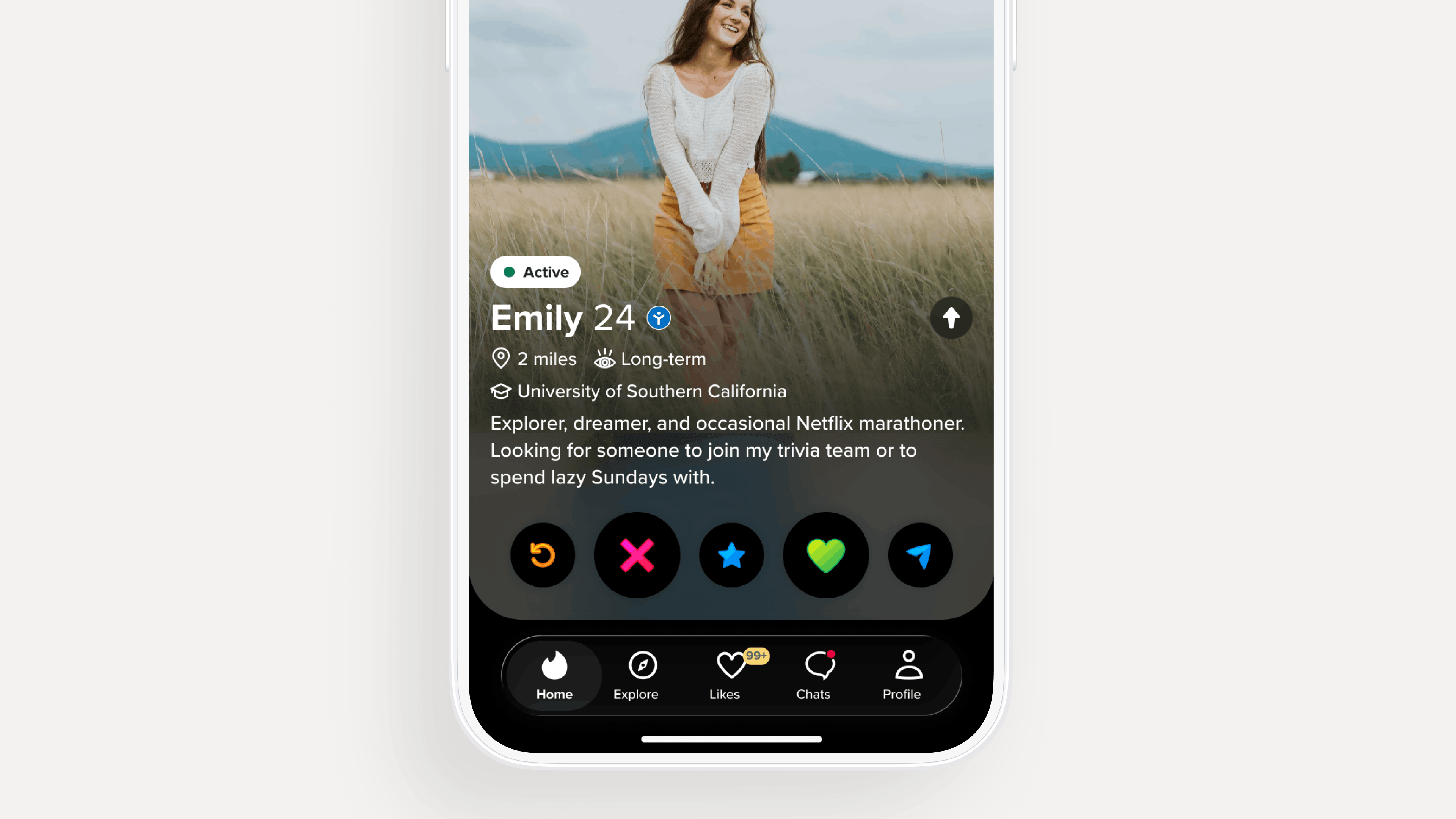
Within Tinder, users who complete the process receive a visible verification signal. That signal gives other users additional context before beginning a conversation. “The badge is a signal to the user that this person can be trusted to be a real and unique person,” Umeki says. “With that trust, people feel more comfortable starting a conversation.”
Tomoaki Umeki, Head of Tinder, Japan.
When users have greater confidence that another account represents a real person, the uncertainty surrounding a new interaction can begin to decrease.
Tinder also designed the experience to make verification beneficial to the overall experience. Verified users can receive greater visibility through additional Boosts, creating an incentive for more people to complete proof-of-human verification. “Once a real human is verified, Tinder users have more chances to meet more people through Boosts,” Umeki says. The goal is to create a positive cycle: as more people verify, World ID becomes a more useful trust signal across the platform.
World ID integration remains in its early stages. Tinder is continuing to evaluate adoption, user behavior and the broader effect of the verification layer. “We are at the phase to keep carefully monitoring how the difference is being generated by introducing World ID,” Umeki says.
Tinder’s long-term ambition is to make it increasingly easy for users to recognize that the people they encounter are real. “I would love to see every individual participate, because that would mean every user can signal they are a verified human,” Umeki says. “That’s the ideal place to be.”
