
Advertising runs on a simple exchange: businesses pay to reach a human audience. Tools for Humanity (TFH), a contributor to World, is helping to make that exchange more reliable by giving advertisers the confidence that the audience is human.
On October 29, TFH announced a business partnership with Ads for Humanity, a company under Hakuhodo DY Holdings, and LG Electronics to pioneer an ad delivery model that ensures ads are shown only to a verified human audience.

From left to right: Eisuke Morita, President & CEO, Ads for Humanity; Hirotake Yajima, Director & Executive Vice President, Hakuhodo DY Holdings; Chairman, Ads for Humanity; Yasuo Nishiyama, Representative Director, President & CEO, Hakuhodo DY Holdings; Ajay Patel, Head of World ID & Chief Revenue Officer, Tools for Humanity; Masami Takahashi, General Manager, Japan, Tools for Humanity; Hyo-jun Im, Head of Next-Generation Computing Research Lab, LG Electronics; Byeong-seon Park, Head of Blockchain Lab, LG Electronics
Each company plays a distinct role. TFH enables individuals to prove they are unique humans via World ID. LG Electronics provides the blockchain technology for tamper-proof ad delivery records, while the Hakuhodo DY Group contributes its extensive network of advertisers, media partners, data and ad delivery infrastructure and creative expertise.
This new model aims to help better inform where budgets go and how campaigns are valued and to deliver stronger returns on marketing investment while protecting users’ privacy and giving them control over the information they share.
Human confidence offers economic value
Bots disguised as humans load web pages, rack up impressions, and click ads. According to Spider Labs, Japanese advertisers lost approximately ¥159.2 billion (US$1 billion) to ad fraud in 2025, up ¥8.2 billion (US$51.7 million) from the year before. Globally, Juniper Research put losses at around ¥13 trillion (US$82 billion) in 2023, a figure projected to more than double by 2028.
When bots inflate impressions and clicks, advertisers lose more than the money spent reaching their audience. They also lose confidence in the data used to decide advertising spend.
Without confidence that a real human saw or engaged with an ad, attribution becomes less reliable and returns-on-investment harder to assess. That uncertainty can weaken demand for ad inventory, erode its value, and reduce revenue for businesses that rely on advertising.
The partnership’s answer to this is to build the Human-Verified Ad Network, which ensures that ads are shown only to people who have anonymously proven they are a unique human with World ID’s Proof of Human.
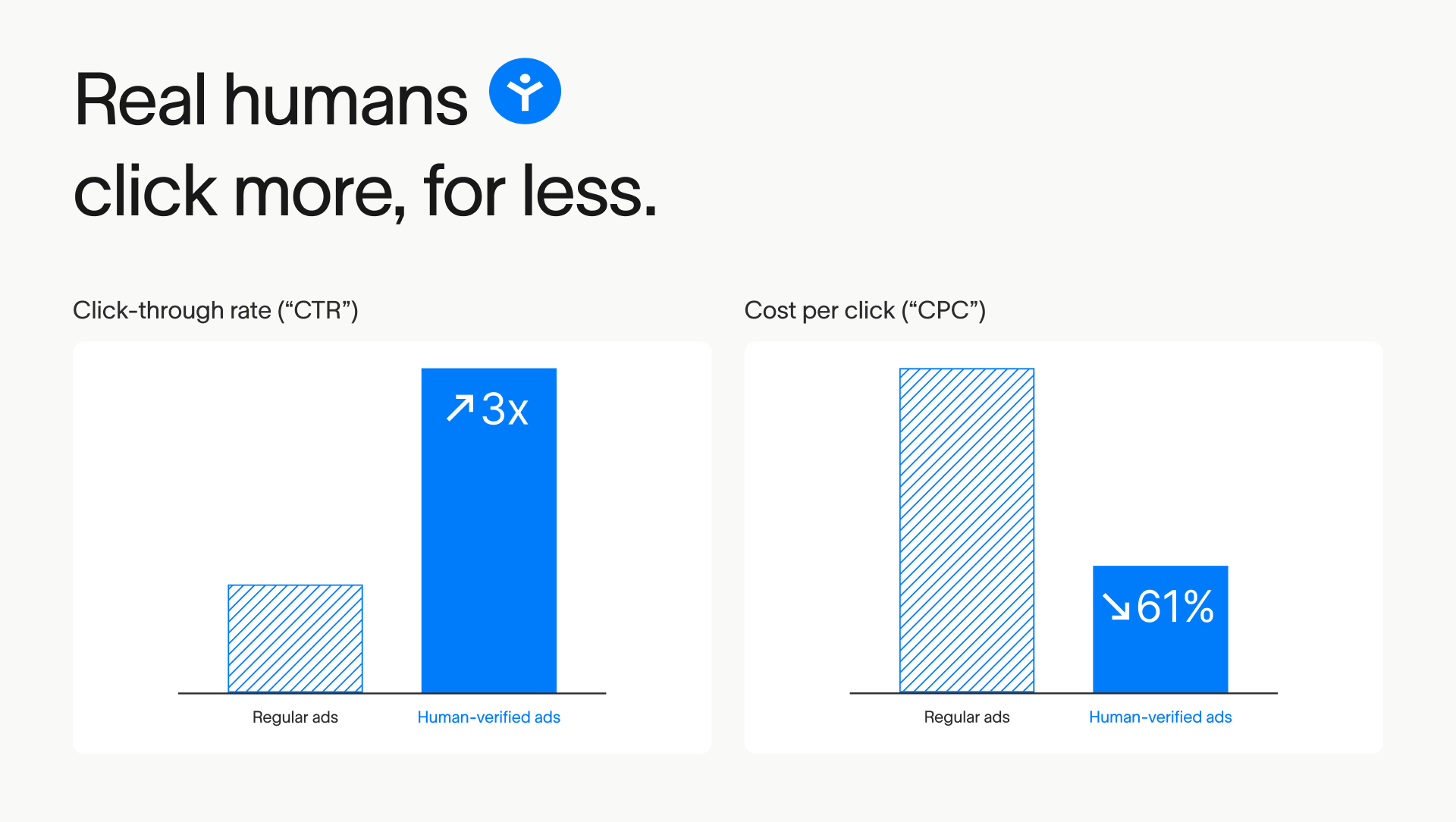
According to reported results from Lawson Entertainment, ads shown only to verified humans delivered about three times the click-through rate of the company’s regular ads, while cost per click fell about 61%. From September 18 to October 17, 2026, these human-only ads were tested against standard campaigns that used the same creative over the same period.
Expanding proof-of-human across Japan’s advertising platforms
Advertisers can now reach people who are verified with World ID’s Proof of Human, across more of Japan’s established advertising infrastructure. Human-Verified Ads, an advertising product offered by Ads for Humanity, is now available on major media platforms including LINE, Yahoo! Japan, Meta, X and TikTok through an integration with AudienceOneⓇ.
AudienceOneⓇ is one of Japan’s largest consumer data platforms and operated by Hakuhodo DY ONE Inc. Through this platform, advertisers can target participating, human-verified audiences using anonymously shared attributes. For example, an advertiser can aim an ad at verified humans in their 30s who are interested in music. Using technology from LG Electronics, each ad delivery is logged on a blockchain, creating a tamper-proof record that helps account for the ads served.
Humad brings the verified, participating audience to the network. Humad is a beta app that allows users who have verified with World ID’s Proof of Human to unlock rewards through ad engagement. Through Humad, consumers can choose which attributes to share, such as age bracket, gender, or interests. These are shared anonymously with AudienceOneⓇ, allowing advertisers to reach relevant human audiences while participants retain control over the information they provide.
Making human audiences measurable with the Human Rate
Ads for Humanity is also introducing the Human Rate, which measures the percentage of an ad’s target audience verified as real humans.
Advertisers often use metrics such as click-through rate to adjust targeting, budgets, creative and ad frequency. As AI agents become more widespread, these metrics offer less certainty about how much campaign activity comes from real humans.
The Human Rate is a proposed common measure to help advertisers evaluate verified-human audience reach, alongside campaign performance. Read together, advertisers and publishers will have a new basis for assessing audience quality and making spending decisions.
The goal is for the Human Rate to become a shared industry standard, helping the advertisers assess audience quality as AI-generated activity grows. That work starts in Japan, building on the three companies’ infrastructure and commercial experience to develop a model that can scale globally.
Building from Japan
The companies’ work in Japan began with a proof of concept that ran in 2025. Ads for Humanity was established in April 2026 and began offering Human-Verified Ads in June. Going forward, the companies plan to explore a range of initiatives, including wider adoption in more markets and how advertisers and platforms can maintain meaningful connections with real consumers as AI agents increasingly act on their behalf.
Human-verified advertising has the potential to deliver stronger outcomes for businesses and consumers alike: greater confidence for advertisers in whom they reach, a stronger basis for publishers to demonstrate audience value, and more choice for consumers over how they participate and receive value while protecting their privacy.
Advertisers or brands interested in finding out more can contact [email protected].
Join the real human network.
Get World ID appRelated articles

Announcements ·
Product ·
World and Cloudflare introduce Trusted Agent Delegation

Announcements ·
Trust is the new chemistry in online dating

Announcements ·
Introducing World ID for banking and finance: AI-safe experiences for enterprises and their customers

Announcements ·