
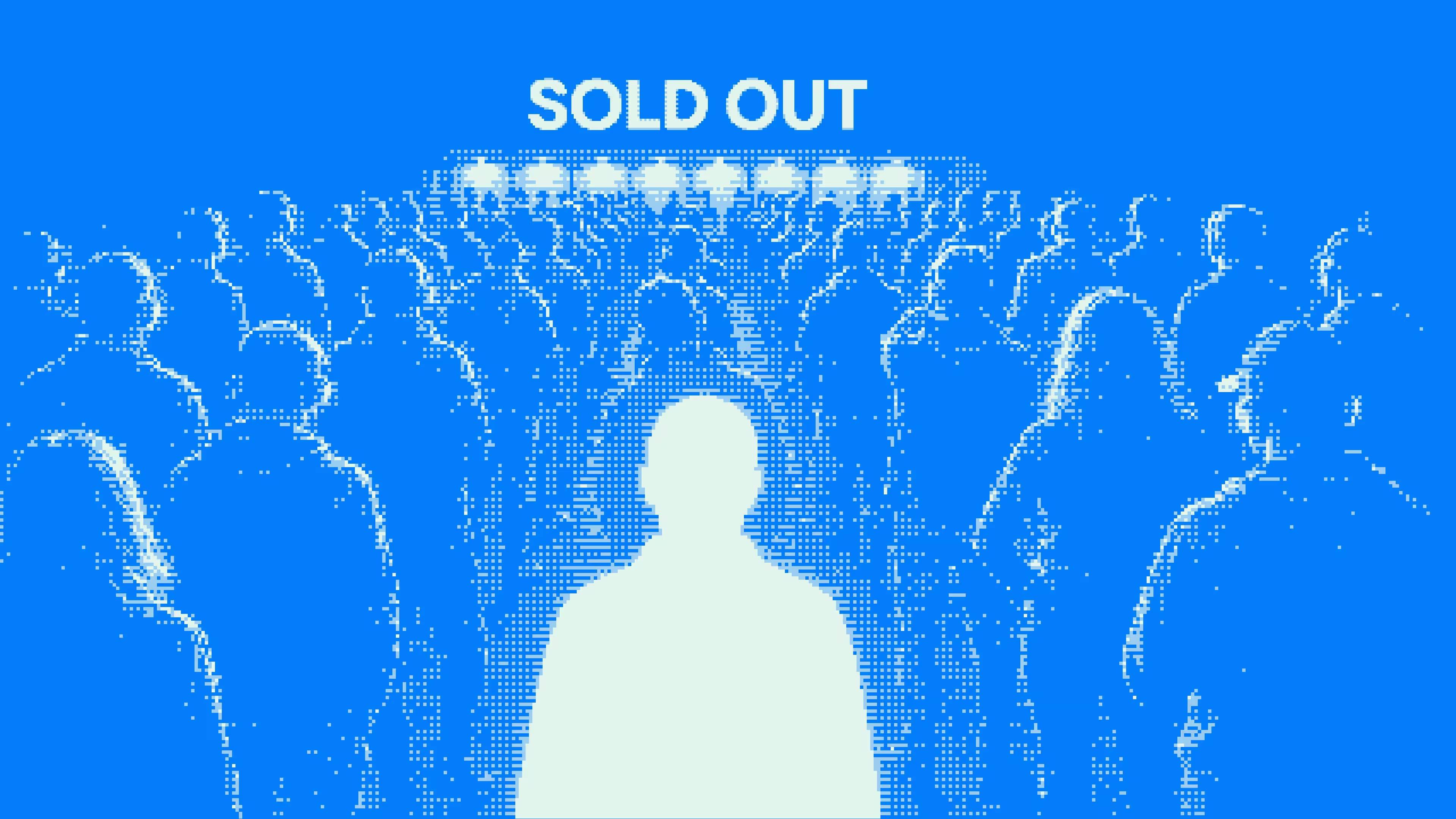
If you could travel back in time to see any concert in history, which would you choose? For British music fans, the answer is Queen's legendary Live Aid set at Wembley Stadium in 1985. In a new survey of 2,000 UK music fans conducted by Perspectus Global, 42% named Freddie Mercury's electrifying 20-minute performance as the show they most wish they had seen live, ahead of Michael Jackson's Dangerous World Tour and The Beatles' farewell rooftop concert in 1969.
Music fans in America carry that same longing, with legends of their own they would give anything to have seen. And you do not need to look to the past to feel how much live music still means. When tickets to Taylor Swift's Eras Tour went on sale, fans set alarms, formed group chats, and traded presale codes for a single shot at being in the room. The devotion was undeniable, a reminder that a great show is still one of the things people will move mountains to reach.
Getting to those moments today is a race against machines.
A global challenge
Automated bots now account for more than half of all web traffic globally, while nearly 40% of all internet traffic consists of malicious bots. As AI-powered automation becomes more sophisticated, the impact is increasingly visible in the live events industry. Recent research across multiple markets highlights how widespread the problem has become:
According to Perspectus Global survey, three-quarters (77%) of Brits surveyed say they have missed a gig they wanted to attend because prices were too high or the queue was too long. Music fans spend an average of 3 hours a year waiting in online ticket queues, and 1 in 3 (29%) believe bots and resellers are buying up tickets before genuine fans can. A further 31% say ticketing sites should do more to block automated bots.
In the United States, 73% of major ticket sales are targeted by bots, and secondary-market prices average 1.8 times face value. In Germany, a YouGov survey commissioned by Tools for Humanity, found that 78% of people see bots and automated programs online as a growing problem, and 53% worry about missing out on tickets to in-demand events because of them.
According to “Sold Out in Three Seconds? Poles Are Fed Up with Ticket-Buying Bots,” a survey commissioned by Tools for Humanity and conducted by Profeina among 1,000 Polish internet users in May 2026, half of respondents have watched tickets to a dream concert or match vanish before they could complete the purchase, while 44% admit to hunting for tickets during work or school hours.
The pattern holds in Asia too. Japan passed a law in 2019 making commercial resale above face value illegal for designated events. In South Korea, reports of illegal ticket resales rose almost 12-fold between 2020 and 2022, prompting an amendment to the Performance Act that bans automated purchasing software.
Fans are ready for a better way: Concert Kit in action
Fans want a fix, and they are willing to participate in one. According to YouGov survey in Germany, 90% of respondents said they would be open to proving online that they are a real human if it meant keeping bots out of the purchasing process. That is exactly what Proof of Human technology from World makes possible.
World's Concert Kit puts this into practice, allowing artists, bands, and management teams to reserve tickets specifically for verified humans. Fans verify once with an Orb, and from then on, their World ID can confirm they are a real human whenever it matters, including at the front of a ticket queue. The actual purchase still happens through existing ticketing systems, so the experience stays familiar for fans and simple for organizers.
Powered by World ID’s Proof of Human technology, Concert Kit works alongside existing ticketing systems to help reduce bot activity and create more authentic access to live events. Concert Kit goes beyond CAPTCHA systems and cannot be bypassed by AI-driven requests; it verifies that a human is on the other side of the screen. The ticketing platform never learns who the person is; it only knows that a verified human is on the other side of the screen. That is something bots cannot fake.
The approach has already been successfully implemented in the real world. At the Humans Only Concert in San Francisco this April, tickets were available exclusively to verified World ID holders. And the band Thirty Seconds to Mars recently partnered with World to bring Humans Only Tickets to upcoming concerts in Munich, Berlin, and Hanover, helping genuine fans get a fairer shot at being in the room.
Ticketing is one early example of what the real human network makes possible. World is building the largest and most inclusive network of real humans, and to date, more than 38.5 million people have downloaded World App, and 18 million have verified their unique humanness with an Orb. World ID is designed to know only one thing about you: that you are a unique, real human. As more of life moves online, that simple assurance becomes the foundation for fairer access to the things people care about most, whether that is a concert, a game, or a conversation.
Live music deserves an audience of real humans. Proof of Human helps make sure the fans singing along got there fairly, ahead of the machines. To learn more about World, visit world.org.
Sumali sa network ng tunay na mga tao.
I-download ang World ID appMga kaugnay na artikulo

Announcements ·
Muse, dots, Instinct, and the question every agent will be asked
Announcements ·
Product ·
peaqOS brings World ID to physical AI and the machine economy
Announcements ·
World: Ikatlong Taon, Phase 3
Announcements ·